







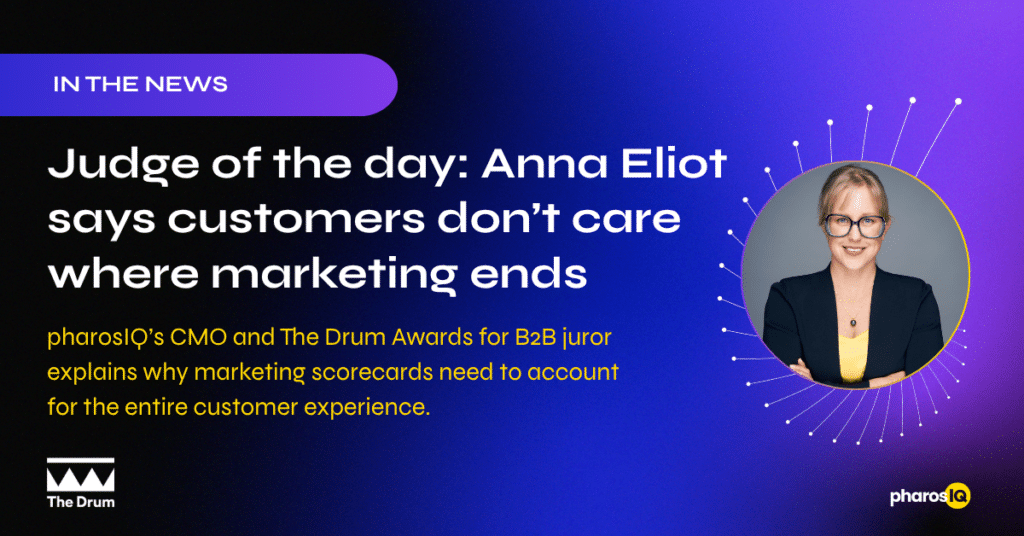
pharosIQ’s CMO and The Drum Awards for B2B juror explains why marketing scorecards need to account for the entire customer experience.
Buyers judge a company on the whole experience, whatever the org chart says about who owns each piece of it. Anna Eliot, chief marketing officer at pharosIQ, thinks too many businesses still miss that, and this year she is judging the go-to-market jury at The Drum Awards for B2B.
Eliot oversees marketing, communications and go-to-market strategy at pharosIQ, which brings data and AI-powered products to market. Her B2B technology background ranges from brand overhauls and product launches to demand generation and corporate strategy.
The most overlooked issue in her discipline, according to Eliot, comes down to measurement. Marketing has grown steadily cross-functional, yet many organizations still measure and reward success within functional silos. “Customers don’t care where marketing ends and sales, product or customer success begins,” she said. “They judge the entire experience.” As the discipline evolves, she expects success to hinge on how well teams collaborate from the first interaction through long-term loyalty.
That view of the buyer informs the misconception she hears most from consumer marketers, who often picture B2B as a stiffer version of their own discipline with a longer sales cycle. “In reality, you’re rarely marketing to one buyer,” Eliot said. “You’re helping multiple stakeholders with different priorities build confidence, align internally and reach consensus over time.” That reality affects everything from messaging and content to channel investment and measurement. The fundamentals of great marketing hold in both B2B and B2C, she said, but the complexity of the buying process makes B2B “a very different discipline to execute well.”
Artificial intelligence now helps her team make sense of the huge volume of customer and buyer data it already holds. “For the first time, we can pull together signals from across the buyer journey and interpret them through our own strategic lens instead of being limited by how a platform chooses to analyze them,” she said. Experience, judgment, intuition and governance remain human strengths. “AI can surface patterns, but people decide what those patterns actually mean and what to do next.”
Pulling scattered knowledge together gets Eliot’s investment for 2026, with the aim of making it accessible to marketing, sales and customer teams alike. “Most companies already have more data than they know what to do with; it’s just fragmented across platforms, systems and people,” she said. “AI has made that fragmentation impossible to ignore.” Organizations that unite their intelligence into a connected, usable foundation will make better decisions faster, she added, and every channel, campaign and customer interaction that follows improves.
Balance is the only answer Eliot accepts to the tug-of-war between brand building and short-term commercial pressure. “You can’t build a long-term brand if you’re only chasing short-term wins, and focusing on immediate commercial results often leads to disconnected marketing that never compounds over time,” she said. The right mix depends on where a business stands and what it needs, and the job gets much easier when marketing, sales and customer experience teams share one view of the customer.
Eliot urges teams to stay relentlessly close to their market by listening to customers and gathering feedback consistently. “The tools, channels and technology will continue to evolve, but understanding your audience will always be your biggest competitive advantage,” she said. She also wants teams to build a habit of adapting, so a change in the market never forces a complete reset.
Curiosity tops her list of traits for the next generation of marketing leaders, since the industry evolves too quickly for anyone to know everything and yesterday’s tactics may fail tomorrow. The leaders who stand out will keep learning, question their own assumptions and adapt as markets and technology change. “More than any single technical capability, I believe the willingness to keep learning will separate great leaders from the rest.”
Be part of what’s next at The Drum Awards for B2B
The Drum Awards for B2B celebrates the ideas and strategies driving growth for brands that sell to other businesses. Jurors like Anna Eliot help recognize the campaigns and thinking raising the bar across the sector. The Drum also runs The Drum Awards, spanning the full breadth of the industry and putting great work and the people behind it in the spotlight all year round.